Land Bank Aquisition Under a Real Estate Deal Structuring Perspective (Part 1) - Investment Objectives and Transaction Structure


Land Bank Access: The First Question in Any Real Estate Transaction
In a real estate transaction, the land bank is generally regarded as the foundational asset that determines whether a project can be formed and developed. From a transactional standpoint, however, “gaining access to the land bank” is not the same as “having the right to implement the project,” nor does it mean that the investor has achieved its ultimate investment objective.
In practice, the same land bank can be accessed in a number of ways. Each approach gives the investor a different degree of control over the land, the project and the cash flows, and each carries a different allocation of capital, legal risk and decision-making authority.
Accordingly, the investor’s question should not stop at “How do we obtain the land bank?”. It should be framed within a broader set of questions: What benefit does the investor want to derive from the land bank? What degree of control does it require? At what point will it commit capital? Which risks does it intend to assume, and which does it want to exclude? And, ultimately, how will it exit?
Answering these questions before selecting a transaction method is critically important. If the structure is chosen solely on the basis of the value or area of the land bank, without assessing its legal status and the investor’s objectives, the investor may complete the acquisition of the asset yet still fail to realize the expected economic value. Access to a land bank should therefore be treated as a transaction structuring problem, in which the target asset is only one component. An appropriate structure must address three questions at once: what the investor controls, how it deploys capital, and which risks it bears.
The Investor’s Control Objectives in a Real Estate Transaction
An investor may target one of five different objects of control, ranging from a tangible asset to a purely economic benefit.

(1) Land use rights
Acquiring land use rights is the most direct approach. The investor seeks to become the party entitled to use the land, and thereby gains greater initiative in managing, using and transacting in the land within the limits permitted by law.
This structure is typically appropriate where the core value of the transaction lies in the land bank itself, and where the investor has sufficient resources and capacity to complete the legal steps required to develop the project. It should be noted, however, that land use rights are only a foundational condition; they do not always automatically confer the right to pursue every development objective on the land. The investor must simultaneously assess the permitted land use purpose, the land use term, zoning and planning, the origin of the land use rights, financial obligations, and other legal conditions relevant to project implementation.
Accordingly, if the investor’s objective is to develop a specific project, the question is not only “Can the land bank be acquired?” but also “Once acquired, what can the investor lawfully do on that land?”
(2) Real estate projects
In many cases, the value of a transaction lies not merely in the land use rights but in the stage of legal completion of the project. A project that has completed investment preparation, planning, land procedures, construction and related approvals may be worth considerably more than an undeveloped land bank with no legal progress, even if the two assets are comparable in location and area. In that case, the investor may consider acquiring the project as a whole rather than acquiring land use rights alone.
This approach is particularly relevant where time is a source of value. The investor is not merely buying an asset; it may also be buying back part of the time the project owner has already invested in developing the project.
The benefit, however, comes with a requirement for deeper due diligence on: the legal status of the project; progress of implementation; obligations already incurred; financial obligations; contracts already executed; existing disputes and claims; and the conditions that remain to be satisfied for the project to proceed.
In this structure, the legal value already accumulated in the project becomes a key component in determining the transaction value.
(3) The legal entity that owns the land bank or project
At another level, the investor does not buy the land or the project directly but instead acquires shares or capital contributions in the legal entity that owns or develops the land bank or project. In essence, this transfers control of the asset through control of the company.
The advantage of this structure is that the investor gains simultaneous access to: the land bank, the project, the legal documentation already in place, the contracts and counterparty relationships, and the company’s operating platform. That same feature, however, creates the principal risk of an equity acquisition: the investor acquires not only the asset but also the company together with its history and liabilities.
Accordingly, where a transaction is structured as an equity acquisition, the scope of due diligence cannot be limited to the land bank. The investor must conduct comprehensive due diligence on the company, covering financial, tax, contractual, labor and litigation matters, guarantee obligations, related-party transactions and contingent liabilities.
(4) Development and exploitation rights
In some transactions, the investor does not necessarily need to own the land bank or the entire project. What the investor actually needs may be the right to participate in developing, managing or operating the project, or to share in its benefits. This is the basis for cooperation structures between landowners and investors.
For example, the landowner may contribute the land bank or rights relating to it, while the investor contributes capital, project development capability, management experience or a business network. In such a case, the value each party brings to the transaction is not necessarily equivalent, and the structure must focus on determining: who holds decision-making authority; who is responsible for funding; who is responsible for completing legal procedures; who bears schedule risk; how profits are shared; who holds the right of disposal over the assets; what mechanism applies if a party fails to perform its obligations; and what the exit plan is.
The essential point is that control and economic benefit can be separated from direct ownership of the land bank, to the extent permitted by law and by the transaction structure.
(5) Cash flows and economic benefits
At a higher level, the investor’s real interest may be neither the land nor the project itself but the ability to generate cash flow from the asset. A financial investor may have no need to develop and manage real estate directly, and may instead be interested in: profits from the project; rental income; proceeds from product sales; return of capital; profit in proportion to its participation; and the right to a share of the project’s value appreciation.
When the objective shifts from “owning the asset” to “receiving economic benefits,” the range of possible transaction structures becomes considerably broader.
This is also why, in structuring a deal, three concepts must be distinguished: ownership/use rights, control, and economic benefit rights. All three may be held by the same party, but they may also be allocated to different parties depending on the structure of the transaction.
Key Factors Shaping the Land Bank Access Strategy
Once the investor has determined what it actually wants to control, the next step is to select an appropriate access method. No single structure applies by default to every transaction. The decision is typically influenced by the following factors, taken together.
First, the investment objective
This is the first factor to be determined. Is the investor buying to: hold long term, develop a project, operate a business, make a financial investment, restructure and resell, or assemble a land bank to support a long-term development strategy?
Each objective leads to different requirements for control, invested capital and holding period. For example, if the objective is long-term project development, control over the land and the ability to implement the project may take priority. Conversely, if the objective is a short- or medium-term financial investment, committing all of the capital to acquire the land may not be the optimal approach.
Second, the desired level of control
Before selecting a transaction structure, the investor needs to define clearly how much control it wants and over which assets. The level of control can range from full control, to joint control, to participation in decision-making, to cases where the investor seeks only economic benefits from the asset or project without directly controlling its operations.
This is one of the most important factors in determining the transaction structure. The higher the level of control, the greater the capital requirement, legal rights and obligations, and responsibilities the investor typically assumes.
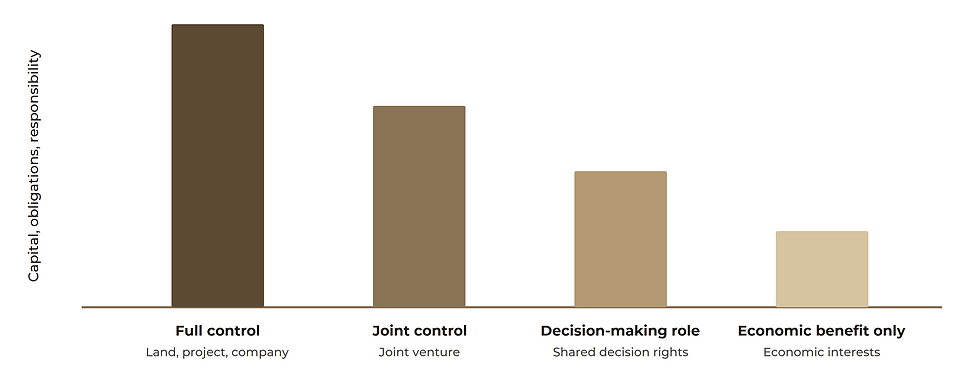
For example, if the objective is to directly hold and control the land bank, the investor may choose to acquire land use rights. If the objective is to take over an entire project or business, a project acquisition or an acquisition of control of the company may be more suitable. If the investor wishes only to co-develop and share decision-making, a joint venture or development cooperation model may be appropriate. And if the primary objective is to obtain economic benefits without direct control, structures focused on economic interests may be considered.
Third, the need for and timing of capital deployment
In a real estate transaction, the capital question is not only how much the investor needs but also when the capital is required and to what extent. This directly affects how the transaction is structured and the level of risk the investor must bear.
Depending on the nature of the transaction, capital may be deployed in stages, for example:

Staging payments, rather than committing all capital up front, allows the investor to tie each payment obligation to the satisfaction of specific transaction conditions. From a risk management perspective, staged disbursement is particularly valuable where the asset or project still has legal conditions to be completed. The investor can maintain its commitment to the seller while disbursing funds only in proportion to the conditions that have been satisfied, thereby limiting the situation in which capital has been committed but rights over the asset are not fully secured.
Fourth, the legal status of the land bank
This is one of the factors that directly determines whether it can be transacted, what can be transacted, and how the transaction is legally structured. In practice, not every land bank an investor approaches is in a condition to be immediately transferred or put into project implementation. A land bank may be in any of several legal states, and each carries entirely different requirements, conditions and risks.

Before determining an investment plan, it is necessary to clarify which state the land bank is in, for example:
Land with complete legal documentation and eligible for transaction: the land use rights have been established, land records are relatively complete, and there are no material legal restrictions on transfer. In this case, the transaction structure can be relatively direct, such as acquiring the land use rights or acquiring the equity or shares of the entity that owns the land, depending on the investment objective and the condition of the entity.
Land in stable use but without fully completed legal procedures: in practice, the user may be managing and exploiting the land on a stable basis, but the land use right certificate, land use purpose, boundaries, area or related registration procedures have not been completed. The issues then become who is responsible for completing the documentation, how long it will take, and what happens if the procedures are not approved. The transaction structure therefore typically needs to link payment, transfer of rights or closing to specific legal milestones.
Land in the process of assembly: the developer or investor does not yet control the entire land bank and is progressively acquiring, receiving capital contributions of, or reaching agreements with multiple land users. The key risk here is the ability to assemble sufficient area, the legal consistency of each individual parcel, and the ability to form a land bank that meets the conditions needed to achieve the investment objective. The investor should pay particular attention to the case where capital has been committed to part of the land bank but the full required area ultimately cannot be assembled.
Land already tied to a project: when land use rights have been incorporated into the structure of a project, the investor’s interest is no longer merely the land use rights. The transaction value may lie in the entire project, the rights and obligations of the project owner, the approved legal documentation, the project development rights and the ability to continue implementation. In that case, the choice between acquiring the land, acquiring the project, or acquiring the equity or shares of the project entity should be considered holistically.
Project under implementation: at this stage, in addition to the land and legal documentation, the investor must consider obligations that have arisen during implementation, such as land-related financial obligations and obligations to customers, contractors, credit institutions, state authorities and other stakeholders. The transaction must therefore be designed to specify which obligations remain with the transferor, which pass to the investor, and how obligations arising before and after the transfer date are to be dealt with.
Project with legal impediments: this state carries a materially higher level of risk. The impediments may relate to zoning and planning, land, investment procedures, construction, financial obligations, site clearance, disputes, or the conditions for the project to continue. In this case, the investor should avoid equating “the value of the land bank” with “the value of a project that can be implemented.” The transaction structure must clearly anticipate how matters will be handled if the impediments are resolved, are not resolved, or take longer than expected.
The key point is that, for the same investment objective, different legal statuses may lead to entirely different transaction structures. In particular, where a land bank is not yet in a “ready” state for transfer or project implementation, the transaction should be viewed as a transition process rather than focusing only on the moment of signing the contract.
The transaction structure must therefore address three issues at once:
(i) where the land bank currently stands legally;
(ii) which steps must be taken to bring the land bank to the state the investor wants; and
(iii) during the transition period, who bears the risk and through what control mechanisms.
This is the basis for designing conditions precedent, payment schedules, holdback or disbursement mechanisms, the parties’ undertakings, and the approach to be taken if the legal status of the land bank does not turn out as expected.
In Summary
Accessing a land bank is essentially a matter of selecting a transaction structure that fits the investment objective, rather than simply deciding whether or not to buy land. The investor should determine in advance the rights it needs to control, the amount of capital it can commit, the implementation timeline and the level of risk it can accept. From there, the transaction structure can be designed flexibly for each deal. Choosing the right structure from the outset will determine how rights, capital and risk are allocated among the parties throughout the life of the transaction.


Comments