Vietnam’s Agriculture: A Key Pillar in the Nation’s Economic Growth


Vietnam has solidified its position as one of Southeast Asia’s most dynamic economies, combining rapid industrial growth with a strong agricultural backbone. While the country advances toward industrialization and digital transformation, agriculture remains an essential pillar, supporting food security, rural employment, and export performance. This overview highlights Vietnam’s recent economic achievements, the continued significance of its agri-forestry-fishery sector, and the nation’s efforts to modernize production for sustainable and high-value growth.
Vietnam’s Economic Landscape 2024–2025
Vietnam’s economy continues to show strong momentum, with its GDP estimated at USD 476.3 billion in 2024, surpassing the Philippines to enter the ASEAN-4. The IMF projects GDP to reach USD 506 billion this year, ranking 33rd worldwide. Among the ASEAN-6, Vietnam recorded the highest GDP growth rate at 7.09% in 2024.

Building on this foundation, the 15th National Assembly has approved a proposal to target at least 8% growth in 2025, signaling optimism and policy commitment toward continued expansion.

Agriculture: A Pillar Amid Industrial Transition
While Vietnam is transitioning from an agriculture-based economy toward industrialization and service expansion, the agriculture, forestry, and fisheries sector remains a vital and high-potential pillar of national development. Although its share of GDP has gradually declined from 17% in 2015 to 11% in the first half of 2025, the sector continues to play a strategic role in ensuring food security, rural employment, and export growth.

Driven by digital transformation, high-tech applications, and green production models, Vietnam’s agriculture is shifting from volume-based to value-added, sustainable, and technology-intensive growth. This modernization not only enhances productivity and quality but also positions the sector as a competitive force in global agricultural supply chains, particularly in high-demand areas such as organic produce, smart farming, and climate-resilient crops.
Strong Export Performance and Trade Surplus
Exports continue to be a key engine of Vietnam’s economic growth, with agricultural, forestry, and fishery products maintaining a strong global presence despite the country’s growing industrial base.
In 2024, agro-forestry-fishery exports reached a record USD 62.5 billion, marking a 19% increase from 2023 and securing Vietnam’s position among the world’s top 10 agricultural exporters.
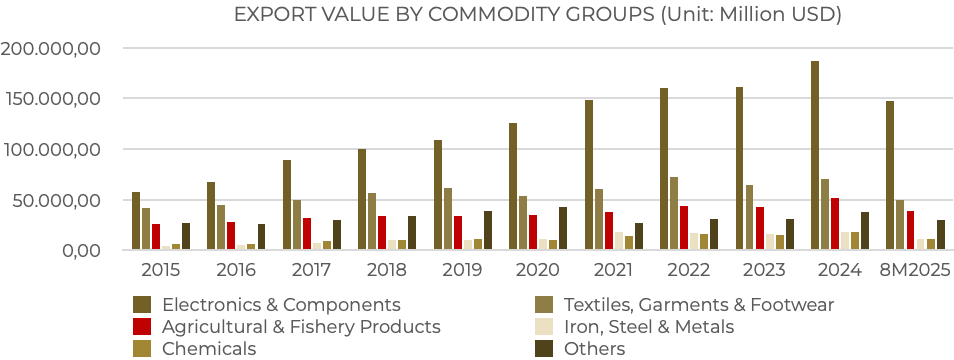
Agri-forestry-fishery products have maintained a positive and growing contribution to the trade balance over the past decade. In the first eight months of 2025, Vietnam achieved a trade surplus of nearly USD 14 billion.
Vietnam’s agriculture sector continues to serve as a cornerstone of the nation’s trade strength. Agricultural and fishery exports remain a key contributor to the country’s consistent trade surplus, helping offset fluctuations in industrial and manufacturing sectors.

Viet Nam’s agriculture has maintained stable annual growth of 2.5–3.5%. Crop production contributed around 50% of total agricultural export value.
In 2024, Viet Nam exported about 9 million tons of rice worth USD 5.7 billion, ranking as the world’s 3rd largest rice exporter.
Coffee exports ranked 2nd globally with 1.32 million tons valued at USD 5.48 billion.
Cashew nut exports reached 730,000 tons of processed kernels—over 80% of global trade—bringing USD 4.37 billion and securing Viet Nam’s position as the world’s No.1 cashew exporter.
Pangasius exports totaled USD 2 billion, up 9% year-on-year, consolidating Viet Nam’s rank as the 3rd largest seafood exporter worldwide.

Technological Transformation and Future Challenges
As of 2025, the country has established 12 provincially recognized high-tech agricultural zones with more than 400ha and 51 high-tech agricultural areas certified by the Ministry of Agriculture and Rural Development (MARD).

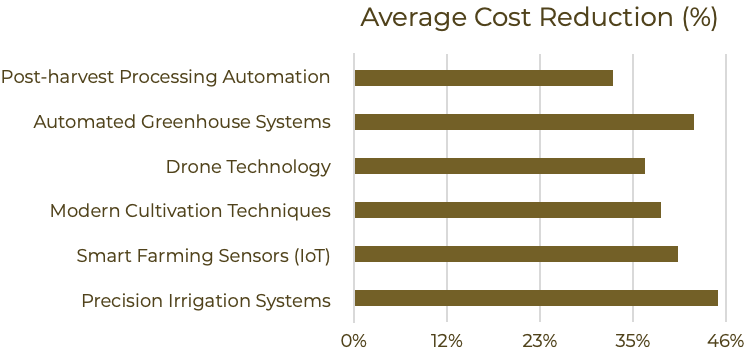
According to MARD, science and technology contribute about 30% to the sector’s value-added, reflecting significant improvements in productivity and sustainability. The application of advanced technologies—such as precision irrigation systems, smart farming sensors, and modern cultivation techniques—has reduced production costs by 30–50%, while post-harvest preservation and processing technologies have cut losses by 5–10%. These innovations not only improve product quality but also help Vietnamese produce meet international export standards. Mechanization has also advanced rapidly, with over 95% of land preparation now mechanized, contributing to labor efficiency and yield consistency.

However, several challenges remain in scaling high-tech agriculture nationwide:
High investment costs: Current funding sources meet only 55–60% of total capital needs, and investment efficiency remains modest.
Low labor quality: The agricultural workforce lacks sufficient digital and technical skills to meet the demands of modern farming.
Land fragmentation and weak infrastructure: Agricultural land remains small-scale and dispersed, while rural roads and logistics systems lag behind economic growth.
Limited and unstable markets: Vietnamese agricultural exports are often in raw or semi-processed forms with low value-added, and many products still lack recognized international brands.
Drones are being deployed for mapping, spraying, and pest control in rice and fruit cultivation areas.

IoT systems and AI-driven farm management platforms monitor soil, weather, and crop health.

Vertical farming: Indoor Farm in Hanoi.

Blockchain and digital traceability systems.

Despite slight declines in recent years due to weather, Viet Nam’s grain food crops output remains sufficient for domestic demand, food security and exports.

Aquaculture remains stable, supported by high-tech applications and intensive farming models that deliver strong economic returns. However, unfavorable weather has negatively affected marine fishing activities.

Vietnam’s livestock industry has demonstrated remarkable recovery and adaptability following the African swine fever outbreak in 2019, which caused a sharp decline in the national pig herd. Since then, the sector has gradually stabilized as disease outbreaks are now largely contained within small-scale farms, while large commercial producers have strengthened biosecurity measures and modernized breeding systems.
Meanwhile, poultry production continues to expand steadily, supported by favorable farming conditions, improved veterinary control, and rising domestic demand.

Conclusion
Vietnam’s agricultural sector stands as both a symbol of resilience and a driver of innovation. Despite industrial expansion, agriculture continues to secure the nation’s food supply, employment, and trade surplus. With ongoing technological adoption and policy support, Vietnam is well-positioned to transform its agriculture into a high-value, sustainable, and globally competitive industry—anchoring the country’s long-term economic growth and reinforcing its role as a leading agricultural power in Asia.


Comments